So, I’ve been thinking about “It’s the exception that proves the rule.”
You know that phrase that we've all probably used at some point or another?
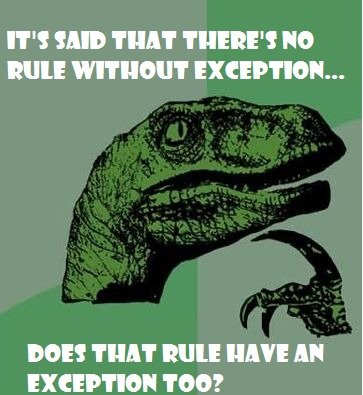 What does it mean, exactly?
It’s an appeal to belief by way of logic. Yeah?
No? Okay, how about:
It’s a “get out of jail free card” for when your science suddenly gets backed into a metaphysical corner and lashes out.
Not yet? Then maybe:
It’s a way to dismiss a counter example to whatever point you are trying to make. Likely a point that had never occurred to you before and you instantly realize that you have no rational means to deny it. At least not until you get some time to think about it. Later.
So you say: “It’s the exception that proves the rule.”
Because the opposite of a thing, of anything, is really a negation of that thing.
The idea I am trying to draw a circle around starts with a question: Why should it work?
Why should making that statement hold any value? And what does it actually mean to say those words? Because doesn’t the exception actually disprove the rule?
It’s more like the exception proves that there IS a rule.

So, putting it all together. The opposite (denial) of a thing proves that there is something to deny.
But how does it do that?
It does it in the the only way that anything can be known. It does it by contrast. Dualism as they call it.
This is where we live most of the time. Dualism. No, not all of the time. But, it’s because of dualism that there is time. Or vice versa.
Time is a measurement of change.
Change (or time) gives you the ability to say that one moment is not another moment.
What follows now is that this lets you say that both moments must exist. Remember? If one is the denial of the other, there must be something to deny.
 Thus, the exception proves the rule.
But that bit back there? Where I say that one (a) is not the other (b)? That is not demonstrable with out assuming the “a” and “b” to begin with.
To be able to say “a therefore b”, “b” had to exist already so that you could prove “a”. And to have “b” to be able to prove you have “a”, well, “a” had to exist already to prove “b”.
Confused? Good.
Because there is another fairly well known philosophical argument that struggles with this same logic: God.
